These bone remains speak to the customs of the Mantaro Valley's early inhabitants: cranial shaping, war wounds, medical treatments, and weaving. Like the rest of the collection, they were found on the surface; the museum has never excavated.
Skulls
Many shaped skulls have been found in the Mantaro Valley. The shape was not congenital: a baby's head was deliberately molded, and the result served as a mark of their family or ayllu.


Shaped skulls
These skulls show different types of shaping: some elongated, probably fronto-occipital, and others widened. All were found on the surface. Some were donated to the museum; others were found as a group, left beside a hole someone had dug.
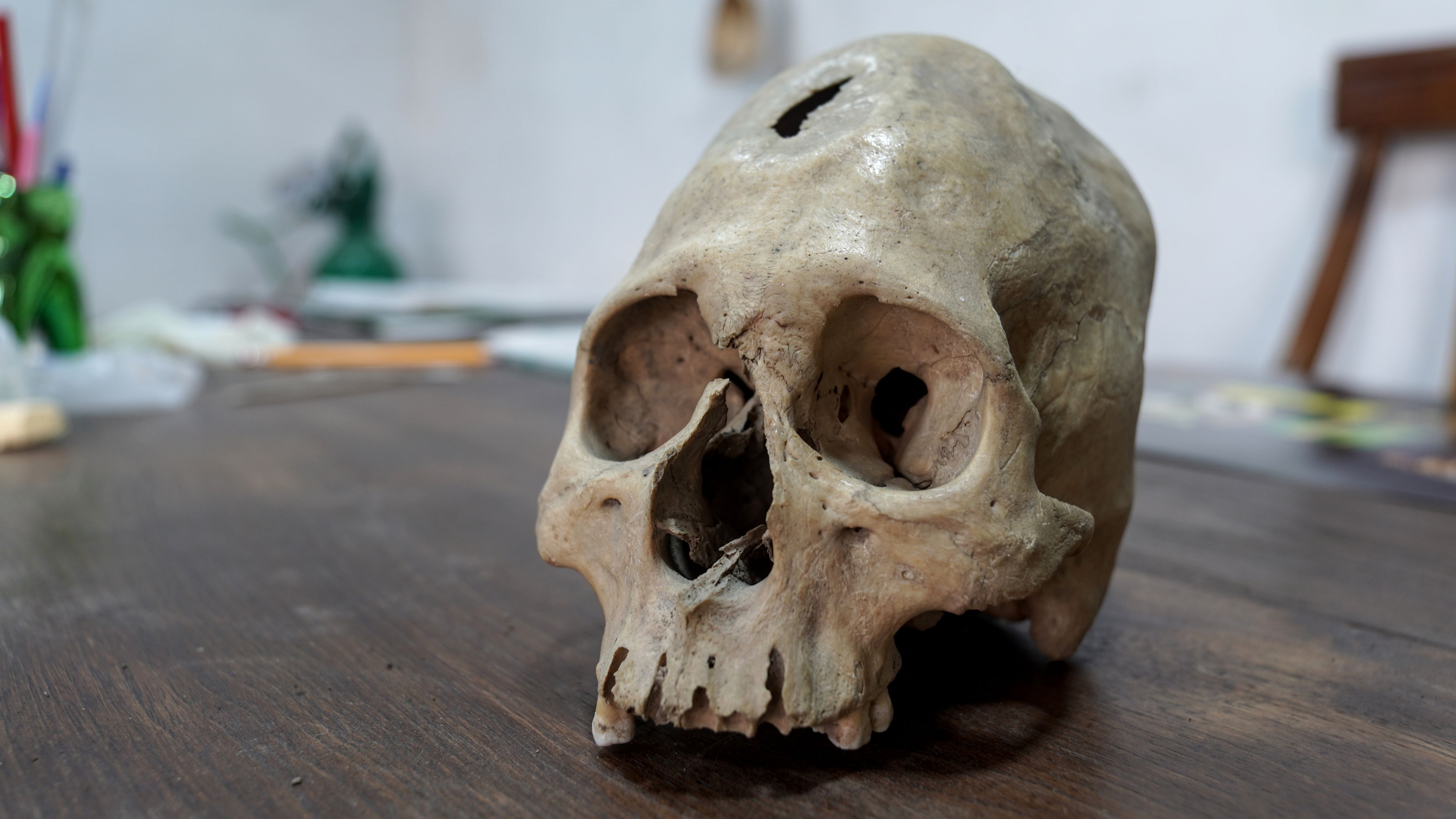
Skull with an injury
This elongated skull bears the mark of a blow, probably from a sling stone, perhaps in war. Skull injuries were common, which is why skulls with trepanation are also found: a simple form of treatment that was practiced here. Found in ancient cultures around the world, trepanation is one of the earliest known forms of surgery.
Bone tools
Besides stone, the civilizations of the Mantaro Valley also worked bone into tools.

Weaving tools
These bones, possibly from llamas, were used in weaving, to pass the threads through.