Stone is at the heart of the Casona Museo Catalina Huanca. Most of the collection is made up of stone objects that trace the development of Wanka agriculture and of the Andean world more broadly. The name itself says as much: in the Wanka language, wanka is a large stone. The Wanka knew of metalworking but preferred to work in stone.
Mortars
Mortars were used mainly to prepare food, but also in rituals. The museum holds more than 330 of them, the largest mortar collection in the Mantaro Valley. There are double mortars made for ceremonies, and small ones probably used to grind herbs, prepare dyes, or for other uses of plants. Most are made of river cobble, the most common stone; those carved from alaimosca stone are unique and the most refined. Each mortar was used with its qulluta, the grinding stone that sits on top.


Simple mortars
These are the most common mortars: simple pieces with a single depression and no ceremonial function. They were everyday tools, used mainly to prepare food, and also to grind herbs or prepare dyes. Many are made of river cobble and others of alaimosca, a green stone with white specks. They are displayed here in rows, and also stacked in a pyramid. How the Wanka worked this stone remains an open question.


Ceremonial and double mortars
This case brings together ceremonial mortars, some very small and with their qulluta at the center, and several double mortars. They were used to prepare brews for ceremonies of thanks to the earth at the start of planting and of harvest. They embody Andean reciprocity: the earth gives us food, and we owe it care in return. Dishes such as shaqta were prepared in the larger mortars.
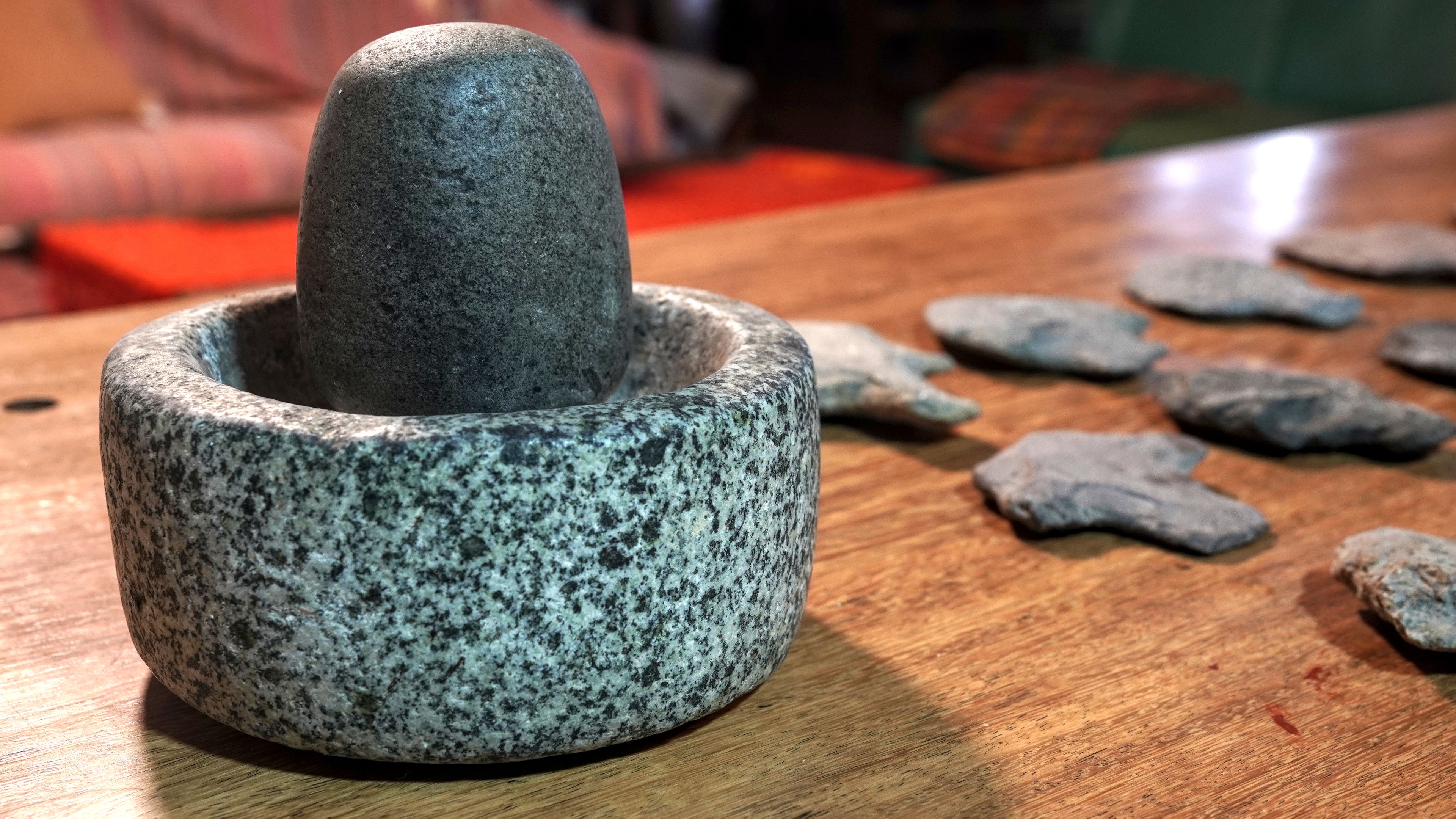
Mortar with pestle
A mortar with its qulluta, the piece that rests on top for grinding.


Anthropomorphic ceremonial mortars and pestles
These ceremonial pestles and small monoliths are Wari. The Wari were present in the Mantaro Valley for about 200 years and worked stone with a strong aesthetic sense. One monolith was left half-carved, just as its makers abandoned it. Another has an elongated head: many skulls shaped this way have been found in the valley, deformed from infancy without harming the person, as a mark of their family, ayllu, or curaca. One of the pestles shows the characteristic Wari eyes.
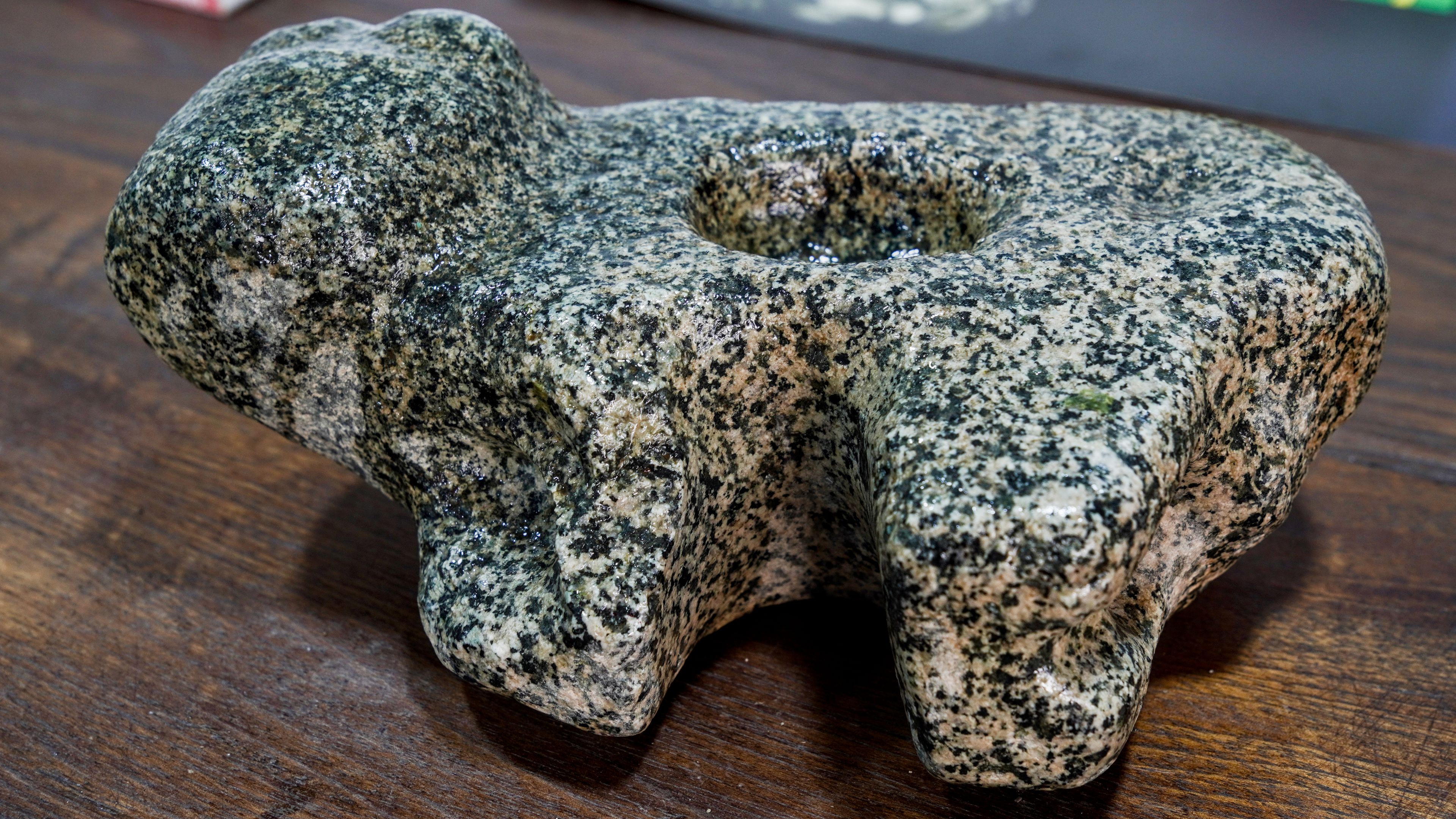
Dog-shaped ceremonial mortar
For the Wanka, the dog was a deity, not an animal to be eaten. Only very important people, such as priests and curacas, ate a small piece, as a way to feel close to such a special being.
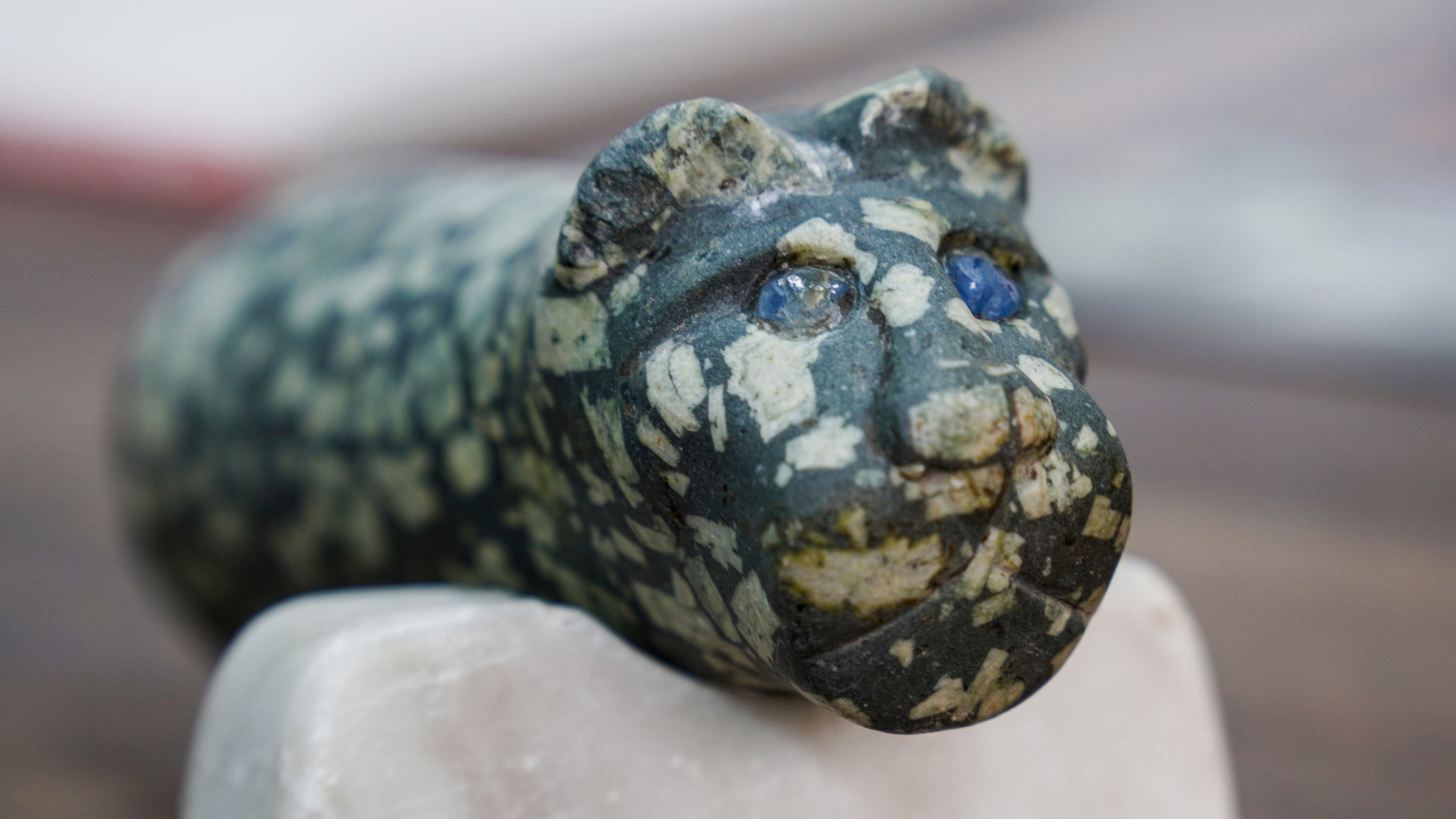
Feline-shaped ceremonial pestle
One of the most beautiful pieces in the museum. This Wari ceremonial pestle, carved from alaimosca stone with lapis lazuli eyes, depicts a feline. It was used together with a ceremonial mortar.
Domestic stone tools
Wanka daily life and farming relied on stone tools: adzes to prepare the soil and harvest, and knives for cutting and skinning animals. Every piece was found on the surface, in fields across the Mantaro Valley; the museum has never excavated.


Adzes
The adze is the defining object of the Museo Casona Catalina Huanca: it is what the Wanka farmed with. The adzes come in different stones and sizes, some so small they suggest children worked alongside adults. Those with sharper points were likely used for planting, and the rounded ones for harvesting herbs. Although some are pointed, they were not weapons: they are hand adzes, which still turn up in fields today. One fine example is shaped like a fish.


Weapons
Alongside the domestic tools, the collection includes objects for hunting, defense, and war: sling stones, boleadoras, and a mace head.


Sling stones
These round stones were deliberately sought out and collected for slings (hondas and warakas), used for defense and hunting. The honda had a short range; the waraka threw much farther. They are so perfectly round that, set out as a table decoration, they were once mistaken for potatoes.


Boleadoras (bolas)
Boleadoras (bolas) were used for hunting; some have a central groove to hold the cord. They were probably also used as offensive weapons in times of conflict. They also served as clod breakers (terroneras): with a wooden handle set into the center, they were used to smash the dry clods left in the fields before planting. In the Mantaro Valley this work began once the land had rested, around August or September, before the rains.

Star-shaped mace head
Most Inka-period objects found in the Mantaro Valley are weapons. The expanding Inka state conquered each town it reached and moved large groups of people to prevent rebellions. This star-shaped mace head was mounted on a wooden shaft through its center and was a lethal weapon.
Anthropomorphic stone carvings
Faces and profiles carved in stone, several with the round eyes characteristic of the Wari style.

Profile monolith
A monolith carved with a profile and a stump on the forehead. It appears unfinished, yet the profile is strikingly beautiful. Its round eyes are unmistakably Wari.

Wishpa
Wishpas were people whose mouths were twisted to one side. This was said to be caused by the “bad wind,” from moving suddenly from warmth into cold. This piece depicts one. In the Andean world, bodies that departed from the ordinary were often regarded as wak’a, touched by the sacred, which helps explain why figures like this one recur in pre-Columbian Andean art.